
Pressure (M) – 101 minutes
The weather. We talk about it frequently. “Gorgeous day.” “Isn’t it blowy.” “It’s raining cats and dogs.” And on it goes.
In movie terms, we often associate it with Hollywood blockbusters – think Titanic (1997), The Poseidon Adventure (1972), Twister (1996) and the like.
But now, along comes a tense, dramatic war film in which an accurate weather forecast holds the key.
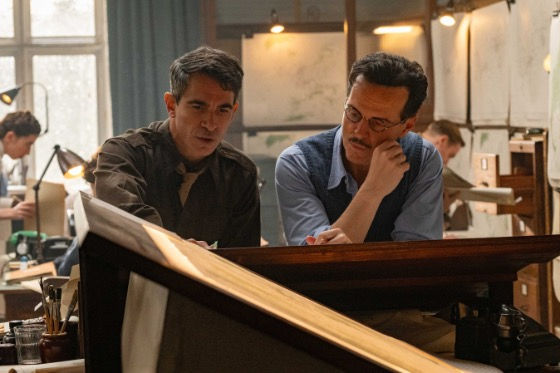
I wouldn’t have thought this when reflecting on a preponderance of charts and data and wind shear, but here we have heart in mouth material.
Co-writer (with David Haig, on whose 2014 play the movie is based) and director Anthony Maras (Hotel Mumbai) has made it so.
I speak about the film Pressure, which deals with the lead up to the D-Day landing in 1944.
It follows the move by General Dwight D. Eisenhower (Brendan Fraser) to execute the Allies’ plan to storm a 50-mile stretch of the Normandy coast at 6:30am on June 5th.
He was understandably toey because a dress rehearsal six weeks earlier had gone horribly wrong.
So, at the recommendation of Winston Churchill, he engaged the services of taciturn Scottish meteorologist Group Captain James Stagg (Andrew Scott).

Stagg immediately locked horns with bombastic US meteorologist Colonel Irving P. Krick (Chris Messina).
Eisenhower had relied upon Krick’s advice, which had been spot on in several earlier campaigns, for the previous three years.
Now, Krick had to report to Stagg, and it was Stagg’s job to give Eisenhower the thumbs up for the massive, planned invasion of the beaches of Normandy.
Krick relied upon historic weather charts (and a look out the window) to indicate that atmospheric conditions at 6.30am on June 5th would be picture perfect.
But Stagg, who called for all the latest information from weather stations within a couple of thousand-mile radius, feared the mother of all storms.
Mind you, Stagg’s curt manner didn’t exactly endear him to many of his subordinates, nor to Eisenhower’s military leaders.
They included obstinate British Army General Sir Bernard Montgomery (Damian Lewis), the Commander of Allied Ground Forces.

With the risk of the secretive operation being uncovered by the Germans, the ultimate decision of when to go was left with Eisenhower.
Also playing an important role in calming the farm was Eisenhower’s private secretary, First Lieutenant Kay Summersby (Kerry Condon).
The brass had gathered at stately Southwick House in Hampshire.
In Stagg’s case, he left behind his heavily pregnant wife, Liz (Tamsin Tospolski), and he found he was effectively banned from speaking with her.
Then a shocking incident occurred.
Pressure (the film) makes for compelling cinema. Director Maras has successfully managed to ratchet up the tension.
That is partly due to the scripting, but also because of the fine acting.

It is in the way Scott carries himself throughout and that includes his body and facial movements.
An excellent Fraser, whose reignited career is tracking extremely well, is stoic and vulnerable as Eisenhower.
Messina is readily able to channel entitlement as Krick, while Lewis brings a similar dynamic to Montgomery.
Also most impressive is Condon, who shows a great deal of empathy in her portrayal of Eisenhower’s confidante.
The attention to period detail is commendable. That extends to the setting, cinematography and costuming.
The depiction of the D-Day landing includes some gut-wrenching scenes.
Pressure holds you in a vice-like grip that doesn’t allow for any easy out. That is what strong film making is all about.
Rated M, it scores an 8 out of 10.


Comments