
Wolfram (M) – 100 minutes
Acclaimed Australian filmmaker Warwick Thornton’s latest movie, Wolfram is another disturbing representation of the country’s colonial past.
It is set in the early 1930s in and around the fictional outback mining town of Henry (named after a grumpy cat Thorton used to have).
It is a time of cruelty and exploitation to try to make it rich by mining Wolfram (an old term for Tungsten, which hardens steel).
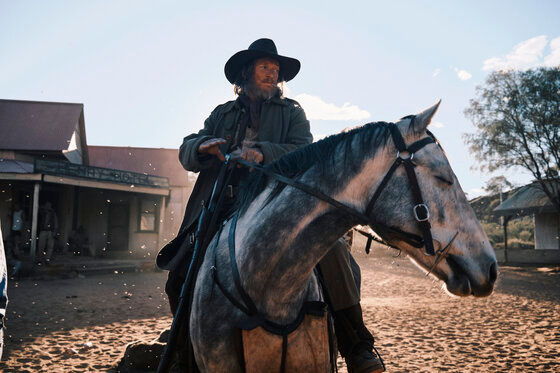
A couple of reprehensible types, the entitled and arrogant Casey (Erroll Shand) and his young offsider Frank (Joe Bird), arrive in town to stake a new claim.
They look to stay with Casey’s old mate, Kennedy (Thomas M. Wright), who is losing his mind to paranoia and drink.
Kennedy is father to a half indigenous lad, 18-year-old Philomac (Pedrea Jackson), whom he treats shamefully. I speak of a master/servant relationship.
A second thread involves two young half siblings breaking free of their white masters who have forced them to work as child labourers in the mines.

Max (Hazel Jackson) is nine, while Kid (Eli Hart) is six – the children of different fathers.
Seemingly abandoned by their mother, they find their way to Kennedy’s property, where they link up with Philomac.
Philomac needs to reconnect with country and kin, so he steals away with Max and Kid. Casey, Frank and Kennedy are in hot pursuit.
Unexpectedly, Philomac, Max and Kid find themselves in the company of Chinese immigrants Shi (Ferdinand Hoang) and his nephew, Jimmi (Aiden Du Chiem). The pair is working their own claim.

Another who has been treated shamefully in the mines is Pansey (Deborah Mailman), the mother of a young baby.
She is desperate to escape her servitude, and her latest partner, Zhang (Jason Chong) agrees to take her by horse and buggy to Queensland.
Before this is over, all the threads will come together to form a complete picture of white man’s shameful treatment of any of different colour.

Based on historic truths, Wolfram is a distressing film, magnificently shot by Warwick Thornton, who has captured the rich browns of the landscape.
It is loosely based on writer David Tranter’s family heritage … and it is also Thornton’s story.
Both their great grandmothers worked as child miners in the desert.
Thornton and Tranter’s 2017 award-winning film Sweet Country focused on the male side of events, while Wolfram tells the female perspective of Tranter’s family journey.

In other words, the two are companion pieces, although Wolfram can readily be viewed without have seen Sweet Country.
I appreciated the strength of the performances, notably the real villain of the piece as played by Erroll Shand, who I found easy to detest from the get go.
As Casey, he is unrelentingly evil.
There is also a lot to be said for Thomas M. Wright’s skittish portrayal of Kennedy, while Pedrea Jackson makes his presence felt as the disenfranchised Philomac.
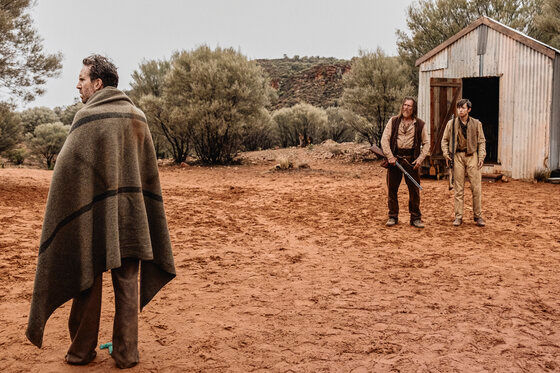
In fact, I felt authenticity was strong throughout.
John Howard is effective as Matthew, a Lutheran priest embracing tolerance, who lives in sin with a local Aboriginal woman.
As a series of negative events play out, the question remains whether Wolfram leaves one with hope.
You will just have to see the film for yourself to find out, and that is well worth doing.
Rated M, it scores an 8 out of 10.


Comments