
The Juliet Letters (The Crossing Machine), at fortyfivedownstairs
- Alex First
- May 2
- 2 min read
Twenty tracks, some deliberately discordant, others melodic, written to one of history’s greatest literary figures – that is the inventiveness of The Juliet Letters.
The changes in tempo reflect significant mood shifts – from bitterness, disillusion and despair to vulnerability, cynicism and obsession.
It is the work of an unlikely pairing, English rock singer/songwriter Elvis Costello and classical, contemporary chamber ensemble The Brodsky Quartet.

Costello first saw The Brodsky Quartet perform in London in 1989. During the same period, The Brodsky Quartet had been to see Costello’s concerts.
They exchanged letters and recordings, and began their collaboration in 1991, with each contributing equally to what became The Juliet Letters.
These were first played publicly the following year and were released as an album in 1993.
The fictional character to whom they were written was none other than Juliet Capulet, the young heroine in the Shakespearean tragedy Romeo and Juliet.

The origin of the work gets back to a professor in Verona who, over a period of years, took it upon himself to answer correspondence addressed to said Juliet.
The inspiration for the album came from the mere idea of this unusual scholarly exchange.
Nothing was off the table – be it a love letter, begging letter, chain letter or suicide note. All were incorporated into the musical missives.
Some were wordy, others wordless, swinging wildly from heart on sleeve, to reflective, to pointedly hostile.

I readily admit that I was taken by the creativity involved in the process.
And now that enthusiasm for the decidedly unusual and different has been taken up by The Crossing Machine, a string quartet founded by Marianne Rothschild in 2018.
The Crossing Machine has worked with legendary international names such as Alice Cooper, Robbie Williams, Roger Daltrey, Elton John and Peter Frampton.
So, too, Aussie notables including Jimmy Barnes, Billy Thorpe, Kate Ceberano, Guy Sebastian and Anthony Callea.
It is easy to see, then, how The Juliet Letters was in their wheelhouse.

With vocalist Jordan Z, violinists Rothschild and Matthew Rigby, cellist Charlotte Jacke and Margaret Butcher on viola capture the desperation and dissonance of the work.
There is both intensity and joy in their collaboration. Seeing them play is energising and invigorating. There are laudable cries in Jordan Z’s outpouring of emotion.
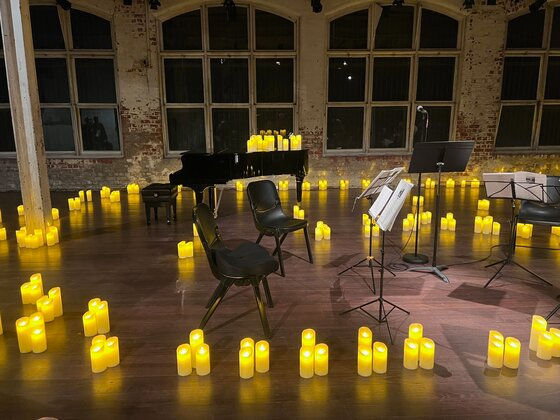
They came together for a special concert performance on the second last night of The Chamber Music Festival at fortyfivedownstairs.
Surrounded by hundreds of glowing candles, which gave the event an ethereal feel, with a shiny black piano as a backdrop, The Crossing Machine delivered big time.
But fear not, for those who missed this performance, the group will soon release their own recording of The Juliet Letters.
It is worth noting that, for the time being, this will not be available on Spotify or streaming services.
You can pre-order the album, either as a CD, or in vinyl, here: https://thecrossingmachine.com.au/index.php/merch-orderform/


Comments